lab · in progress
The Kreuzzargenstuhl as a 3D configurator
The Kreuzzargenstuhl by Max Bill (1952), made by wb form, is our second configurator and still in progress. It shows seven finishes in beech, oak and walnut, upholstery in leather and fabric, the exploded view, the drawing and the details with a camera flight; product data and finishing touches will follow.
- design
- max bill, 1952
- maker
- wb form
- as of
- November 2026
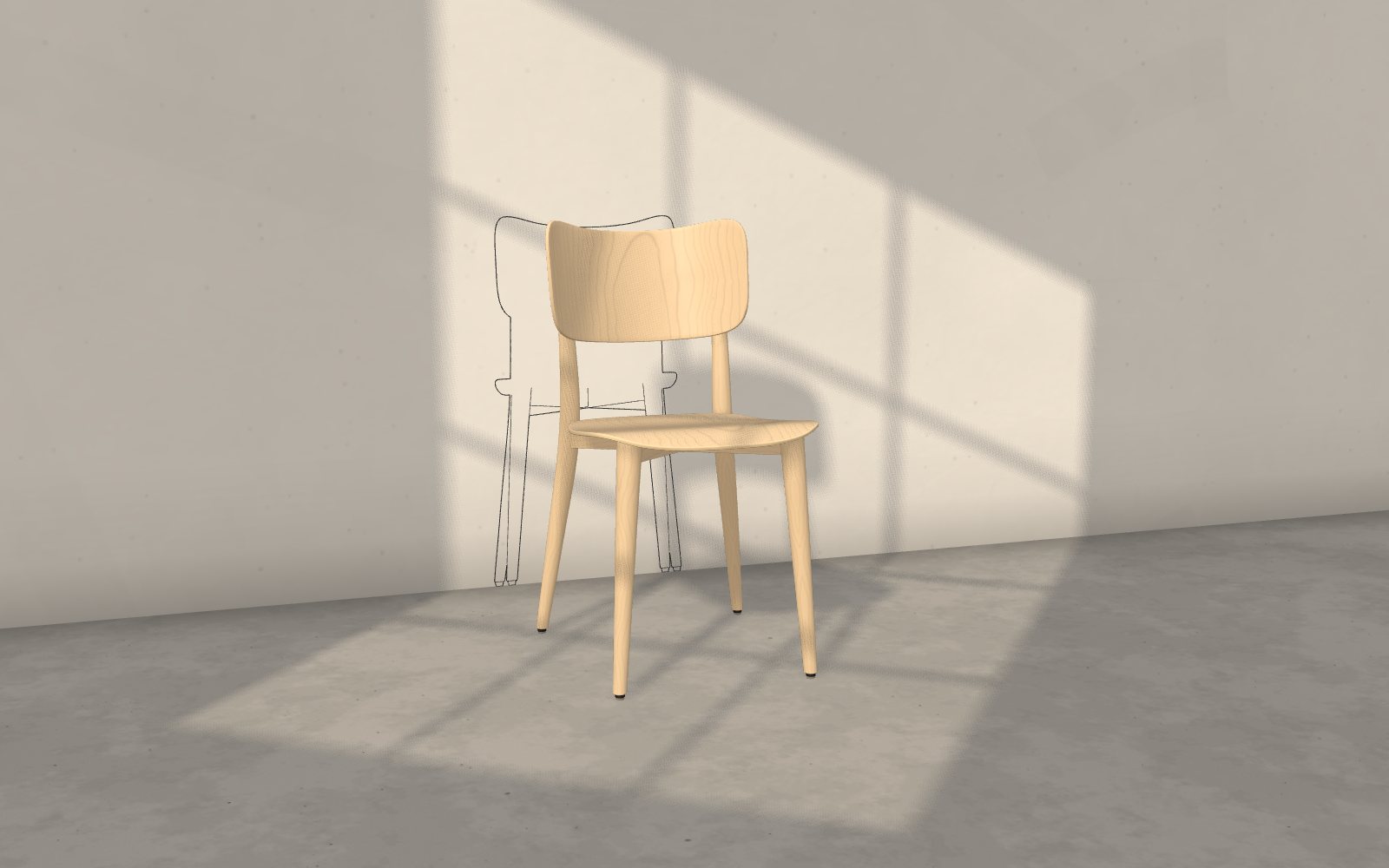
This configurator, with enquiries to you and your dealers, for your piece.request a feasibility check free · reply within 2 working days
01 · shows
Details: what the configurator tells
The rings on the chair open short cards. Here are the same texts to read.
- 7 finishes: beech, oak, walnut, black
- Moulded plywood shells and crossed rails
- Upholstery on the seat or on seat and back, in leather and fabric
- Exploded view and drawing at 1 : 1
- Details with camera flight and story
- View in your room (AR)
crossed rails
solid beech
Two rails cross under the seat, let into each other where they meet. The crossed rails are Max Bill’s invention and give the chair its name: they carry the seat in the middle and give it the greatest possible stability.
seat and back
moulded beech plywood
Seat and back are thin shells of moulded plywood. Against the strong frame they show how the chair is built, and it is remarkably comfortable. In the fifties the Swiss Werkbund gave it its award ‘die gute Form’.
back and legs
solid beech; beech dowels
Where the back rests, each back leg is planed flat. The back is glued on there and held by two beech dowels, which stay natural even on black legs.
felt glides
felt in a plastic cup
Each leg stands on a clip-on glide with a felt pad. It protects the floor and can be replaced on its own. Plastic glides are available on request.
signature
printed
On its rail every chair carries Max Bill’s signature with the wb form mark, and again under the seat, there with an embossed serial number. Designed in 1952, the chair has been made as a re-edition since 1999.
Designed in 1952, re-issued since 1999. Awarded 'die gute Form' by the Swiss Werkbund in the fifties. The crossed rails are Bill's invention: they carry the seat in the middle and give the chair the greatest possible stability. The contrast between the thin shell and the strong frame shows how it is built.
02 · Finishes
7 Finishes
| Wood | natural beech · natural oak · natural walnut |
|---|---|
| Black | natural beech, legs lacquered black · natural oak, legs lacquered black · beech, black stain · black oak |
product data
| dimensions | 440.4 × 562.6 × 825.1 mm |
|---|---|
| dimensions | 48 × 52 × 78 cm |
| dimensions | 48 × 52 × 78 cm |
| seat height | 46 cm |
| weight | 4 kg |
| glides | felt; plastic on request |
| maker | wb form |
| material | Seat and back moulded plywood, legs solid wood: beech, oak or walnut. Origin: beech and oak from central and south-eastern Europe, American walnut from North America. |
03 · build
About this build
| Status | In progress: model, woods, upholstery, details and the opening are built; product data and finishing touches will follow |
|---|---|
| Model | Seat and back as moulded shells, legs and rails generated from the dimensions, checked against wb form’s 3D model |
| Material | Beech and oak as drawn veneer, walnut from a scan |
| Languages | German and English |
Both pieces are designs by Max Bill and are made by wb form. We show them with wb form’s consent.
What would your piece look like here?
Send us a link, a few photos or a drawing. Within two working days you receive a feasibility sheet: what can be shown, what it costs, how long it takes. Free and without obligation.