craft
How we build: true to construction, true to material
We build a piece for the browser the way it is built: from its real parts, measured on the piece, with surfaces from photographs and scans of the samples. Then we place it in a room with daylight and inside its own drawing, so that size, colour and construction make sense. This page explains how, using the Ulmer Hocker as the example.
- by
- Stefan “Pepe” Hiller, founder
- as of
- November 2026
01 · the piece
Construction: we measure the real piece
We start from the workshop drawing, but we build what we measure on the piece.
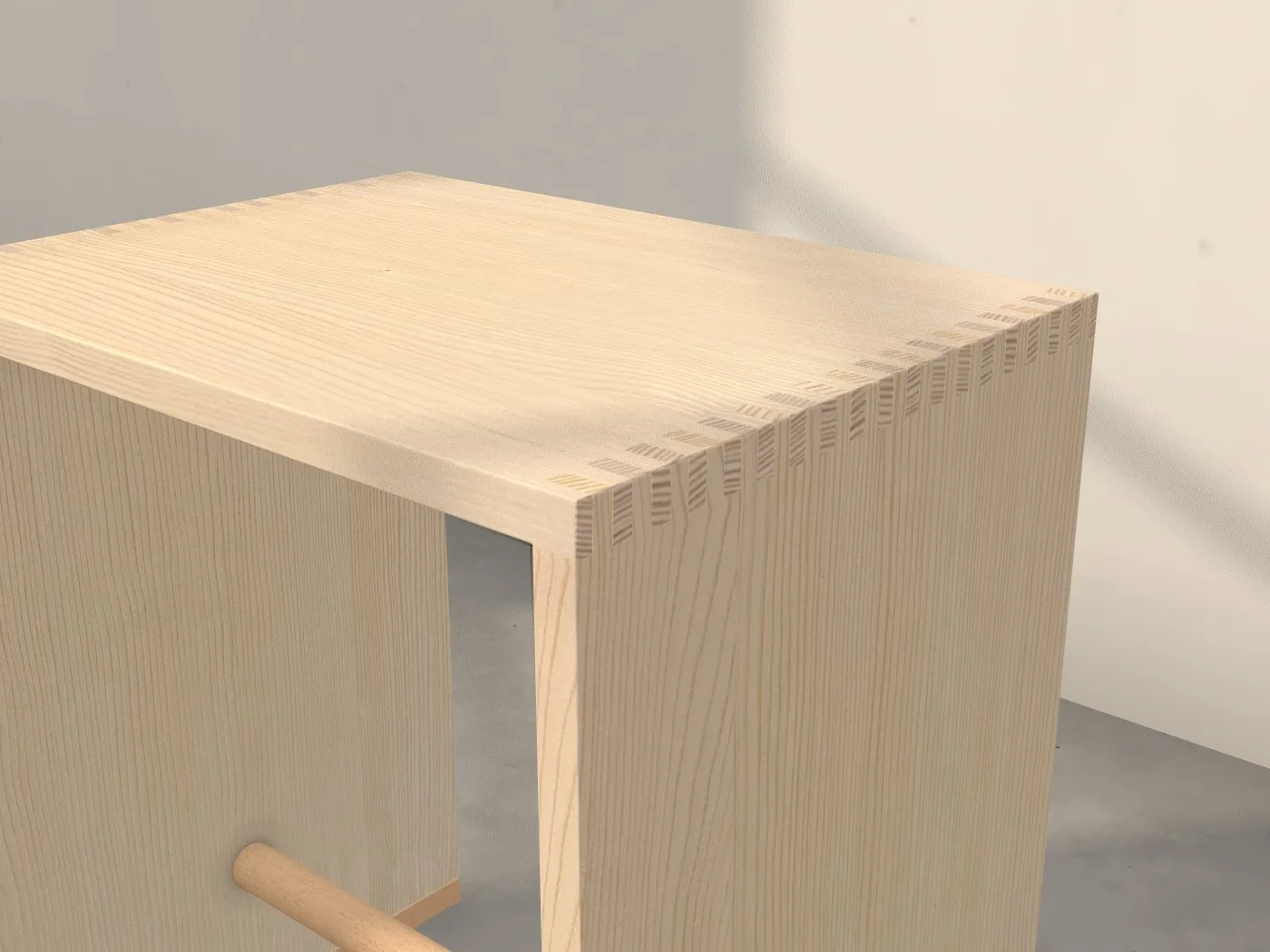
Old drawings are often no longer what the workshop builds. On the Ulmer Hocker the drawings’ finger joints did not match the stool. Counted and measured on the piece: 8 mm fingers, 6.25 mm at the ends, 37 divisions per edge.
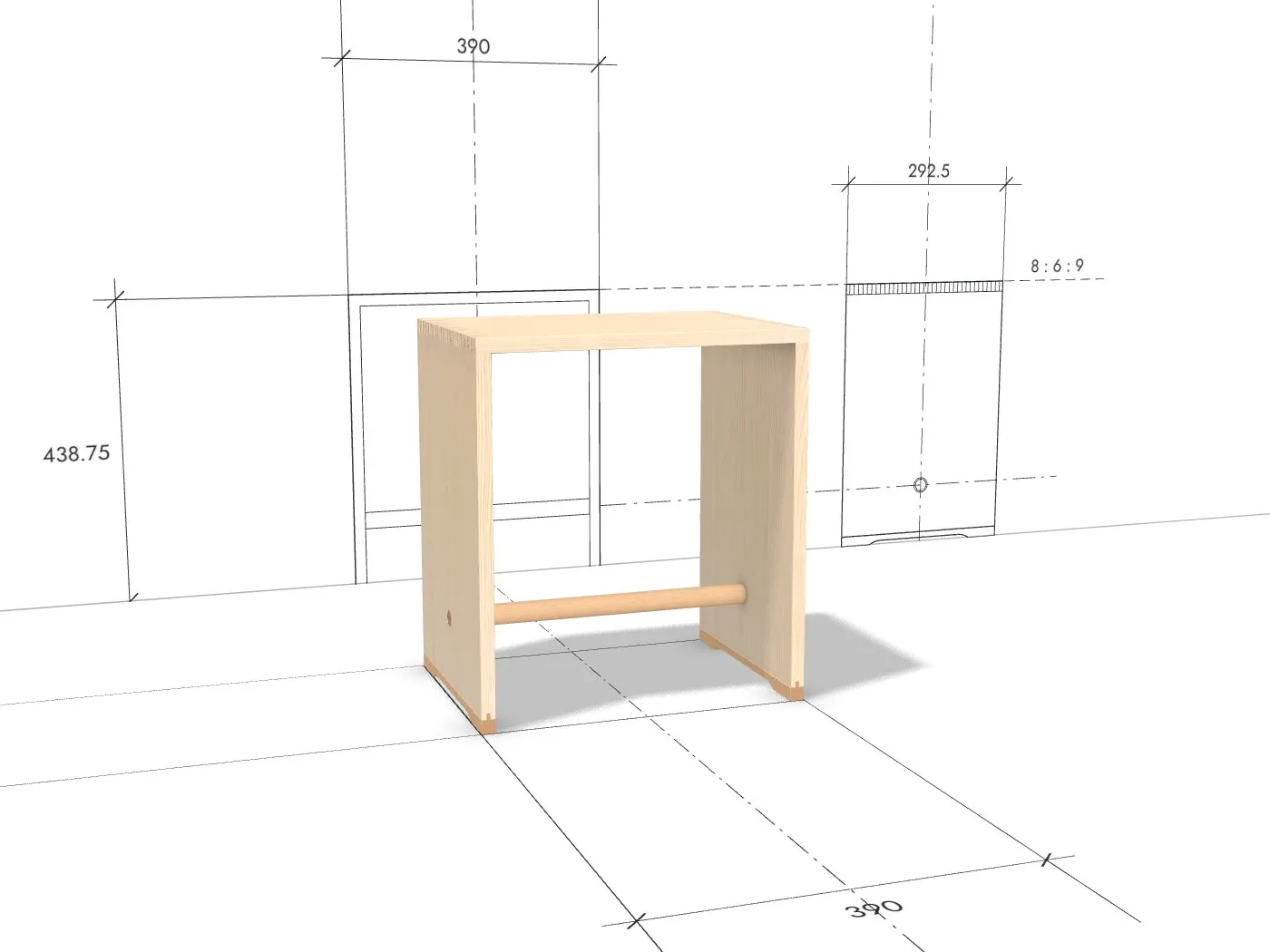
The model is made from one file holding these numbers. From the same file the configurator draws the 1 : 1 plan and writes the product data. When a dimension changes, model, drawing and product data agree again afterwards.
| Fingers | 8 mm, 6.25 mm at the ends |
|---|---|
| Divisions | 37 per edge |
| Dimensions | 390 × 292.5 × 438.75 mm |
| Boards | 17 mm spruce |
02 · material
Material fidelity: wood like the sample
The surfaces come from the real samples, not from a texture library.
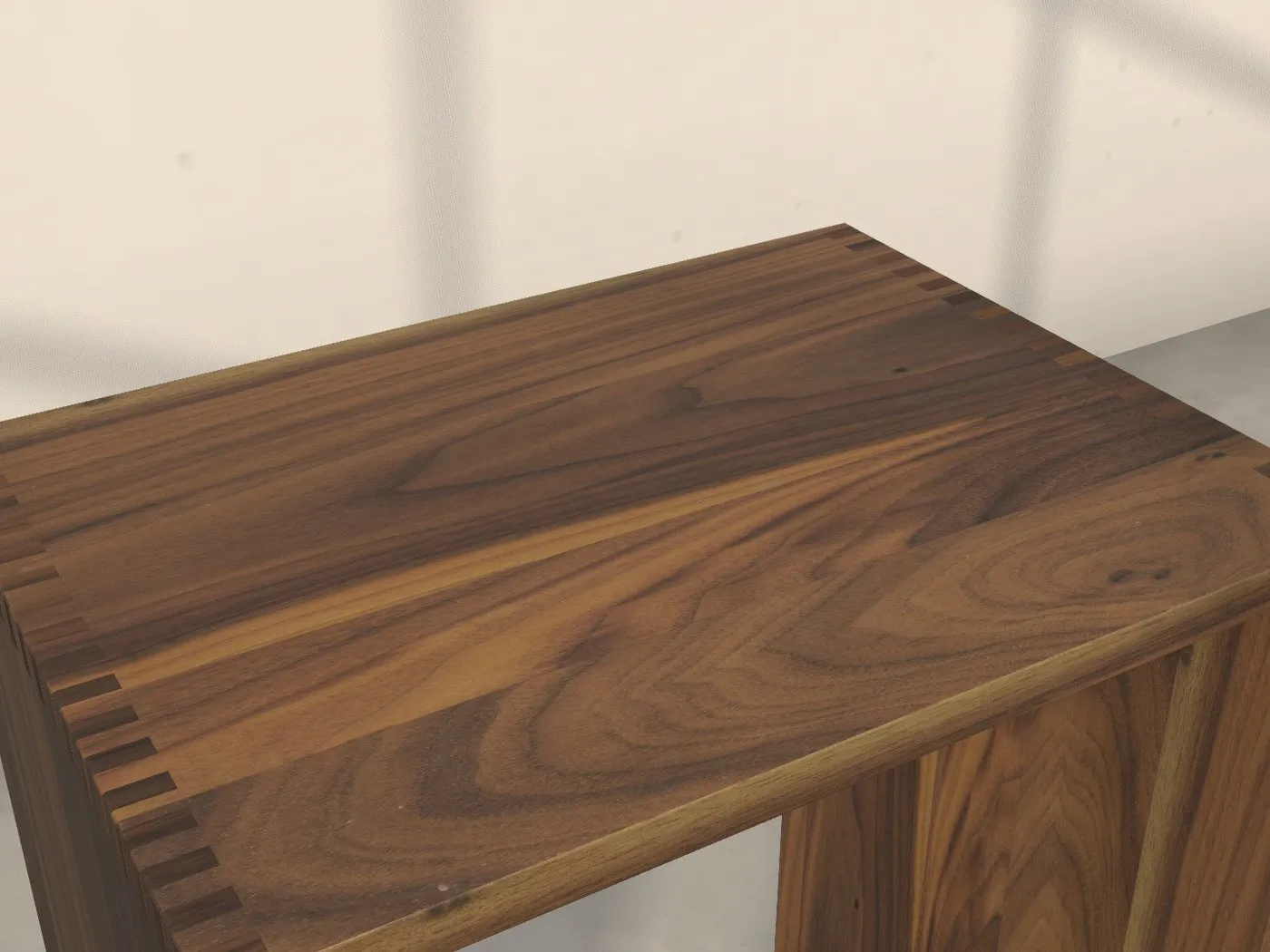
The Ulmer Hocker’s spruce comes from photographs of the stool itself: rectified, the light evened out, the colour matched to two flatbed scans. The walnut comes from a flatbed scan of a seat, laid on at true scale, each part on its own stretch of it. The colours are measured on scans of the stain samples.
In the browser we show the colours as measured. No filter makes them stronger or warmer. When a wood looks wrong, we adjust the light, not the colour.
03 · room
Room and scale: why the room matters
You only understand a piece in a room: with light, shadow and a sense of scale.
In front of grey every piece looks the same size. So ours stands in a room with daylight, on a floor that catches its shadow. Its drawing stands at 1 : 1 on wall and floor, made from the same numbers as the model.
Three lights are built in: sun for the mood, north light for judging colour, a white studio for the catalogue. The packshots are made in the studio light, from the same model.
04 · speed
Speed: fast on phones too
The configurator runs smoothly on laptops and phones because it is tuned for each.
Phones and tablets get a quality tier of their own: fewer pixels, smaller shadow maps. Laptops and computers get the full resolution. Model and photographs are separate files; the other woods load quietly once the scene is up.
We measured this on real devices, not in a lab. We keep measuring the time to the first picture on a first visit and will show it once it is good enough.
| Laptop | 120 frames per second |
|---|---|
| iPhone 11 Pro | 60 frames per second |
| Repeat visit | 1.2 s to the first picture (iPhone) |
| Measured | 14.11.2026, Chrome |
05 · limits
Limits: what we deliberately do not do
We leave out what makes a piece prettier but less true, and what spies on your customers.
No image filters that shift colours. No photo-studio pictures passed off as the configurator: every image on this website comes from the model. No numbers without a date and a device.
No tracking in the configurator, no cookies, no plug-in. The configurator loads all its files from its own address and sends something only when someone submits an enquiry.
Sources
- Dimensions and fingers: measured on wb form’s Ulmer Hocker, November 2026.
- Frame rates: measured with the configurator’s built-in readout (?fps=1) on a laptop with Intel Iris Xe and an iPhone 11 Pro, 14 November 2026.
- The Ulmer Hocker is a design by Max Bill and Hans Gugelot, 1954, made by wb form. We show it with wb form’s consent.
Stefan “Pepe” Hiller, founder · as of November 2026
Your piece, built like this?
Send us a link, a few photos or a drawing. Within two working days you receive a feasibility sheet: what can be shown, what it costs, how long it takes. Free and without obligation.